
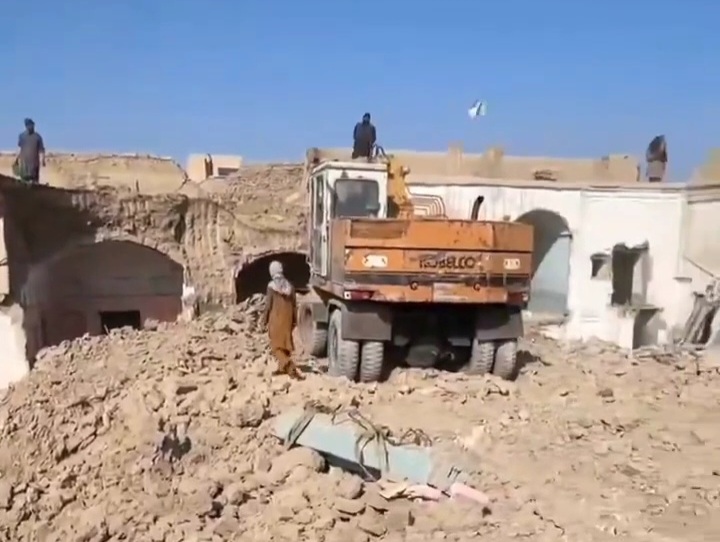
Historians say the site, which functioned as a bank of its time, has raised serious concerns about the fate of Afghanistan’s historical heritage. According to initial information, an urban development plan has been applied to the area, though it remains unclear what type of project is intended for the site.
Former cultural figures in Kandahar say the location once managed the Ahmadshahi state’s financial assets, public trust funds, and the economic affairs of the empire. The historic building is located in the heart of Kandahar city, adjacent to the provincial governor’s office—an area where, as locals say, every step is history and every brick tells a story.
Historians warn that demolishing such structures without historical research, documentation, or respect for Afghanistan’s cultural heritage amounts to sacrificing history in the name of development.
Sardar Wali, head of the Mandigak Foundation and a historian, described the demolition as an erasure of historical memory. He called on Kandahar’s academic, cultural, and responsible institutions to study, register, and preserve such sites, rather than allowing them to disappear under the pretext of urban planning. “If history is destroyed, identity disappears with it,” he said.
Meanwhile, Abdul Karim Khurram, former Minister of Information and Culture during the previous republican government, wrote on his X (formerly Twitter) account that he had recently seen images of the restored house of Ahmad Shah Durrani and felt encouraged, but was deeply saddened to learn of the demolition of another important historical building from the same era.
He said the value of such ancient structures is greater than gold, stressing that destroying them is equivalent to destroying history. “This is extremely regrettable,” Khurram added. “No living and conscious nation cuts off its own roots. I hope that in all provinces of the country, buildings considered historical monuments are given serious and full protection.”
So far, Taliban authorities have not issued any official statement regarding the demolition of the historic site.
According to historians, Afghanistan has a history spanning thousands of years and is considered one of Asia’s countries where traces of multiple civilizations remain preserved. From the Aryan civilization to the Greco-Bactrian, Kushan, Islamic, and Ahmadshahi periods, the country is often described as a living museum of historical monuments and ancient architecture.
Archaeologists say historical monuments in Afghanistan are not merely physical remnants of the past, but fundamental pillars of national identity, cultural memory, and collective heritage. These structures serve as living records of governance, urban development, economic systems, religious life, and social order, transmitting knowledge from one generation to the next.
This comes as Afghanistan’s historical heritage has suffered severe damage over recent decades due to war, neglect, illegal excavations, and rapid urban expansion. Many historic structures have been destroyed, damaged, or erased under the name of development projects. Experts emphasize that protecting historical monuments is not only a cultural responsibility but also a national and legal obligation, noting that proper documentation, research, and professional preservation are essential to safeguarding history and preserving identity for future generations.